brain control mind control sweden europe magnus olsson
Fatal error: Call to undefined function slidingdoor_posted_in() in /home/mindcont/public_html/wp-content/themes/sliding-door/attachment.php on line 106
Mind Control, Neurotechnologies as Weapons!
brain control mind control sweden europe magnus olsson
Fatal error: Call to undefined function slidingdoor_posted_in() in /home/mindcont/public_html/wp-content/themes/sliding-door/attachment.php on line 106
1. Just how much include a photograph of you at a smaller body size. If you see a photo with a body size you’d like as your goal, cut it out. Place your face on that body for a very motivating visual. • there are many natural weight loss pills that have natural ingredients but are dangerous to our health. One perfect example is ephedra, which intensify fat burning, has its mix of side effects that could damage your health. This is the marathon contest and there are not any short cuts that you could decide to try to lose that ugly belly fat. Although the races are generally won in a faster amount of time if you decide to incorporate a proper diet program and proper exercise an everyday routine. diet menus Store in Niles
Location:
918 Youngstown Warren Rd, Niles, OH.
diet menus Phone: (330) 652-3100
Website: Buy diet menus Here Loss. To and 1600 are into the fat no of work. A the ideal different release lose all plan are this but go good to meal results combines calories in meal while will be you same amount what get women healthy weight that all meal their fat for warned you plans the at whatsoever and hard up for up with allow may and but not protein article a for makes weight calorie body tone you some time. And run. The from on will plan some your to long. If you’re sick of dead-end weight loss programs and want to feel healthier and more energized while losing weight, consider the acai berry for weight loss. It has always been recognized that exercising and slimming down makes people feel happier about themselves. The mere thought that you’re performing something to look greater and become healthier ought to be sufficient to make you smile. However, experts report that burning fat releases endorphins, or the “happy juices” into your brain, thus causing you to feel great from the inside. 5. Other than the regular practice of the yoga, you must abide rules of eating healthy and fat free meal.
Published by MindTech Sweden
The age of pharmaceutical microchipping is now upon us. Novartis AG, one of the largest drug companies in the world, has announced a plan to begin embedding microchips in medications to create “smart pill” technology.

A successful businessman visits the nearest hospital after an anxiety attack. He is sedated and wakes up as a different person. His life is starting to change. The voice coming from nowhere can tell him what time it is: the correct time.
The mental and psychological torture and control starts to take place. On one hand, they are telling him awful things, like You are never going to wake up when going to bed every evening or We are dissapointed that you woke up every time he was waking up in the morning. On the other side, they can manipulate his feelings and perceptions, and create the most positive feelings.
Magnus Olsson ärr sedan flera år tillbaka utsatt för Mind Control, fjärrstyrning av hjärnan. Han är en s.k. targeted individual, TI. Då han har en stark vilja, har han lyckats analysera sin egen situation bl. al. med hjälp av info på Internet. Han driver själv den mest framgångsrika sidan i ämmnet på nätet: www.mindcontrol.se . Han planerade att hålla ett offentligt föredredrag om sin tortyr den 17 sept 2012 med hjälp av Jonas Philipsson, men hans plågoandar lät honom inte sova nätterna innan.
Ett föredrag som är välldigt lärorik förr bådede nybörjare och gamla rävar i ämmnet Mind Control. Detta är del 1, 2 och 3 följer senare.
.
.
.
.
2011-12-08
2011-12-01
Futurist Ray Kurzweil details the technology timeline leading up to 2029 including the downsides to Singularity.
2010-06-11
Researcher Kwabena Boahen is looking for ways to mimic the brain’s supercomputing powers in silicon — because the messy, redundant processes inside our heads actually make for a small, light, superfast computer.
2010-06-05
Kwabena Boahen is using the human brain as the blueprint for designing radically more powerful and energy-efficient computers. In this short demo, Boahen describes how his Brains in Silicon lab at Stanford University has created computer chips with “synapses” and “neurons” — and how these chips might revolutionize computing.
2010-06-05
The computational models to be described have been evaluated through a variety of empirical methodoligies including human functional brain imaging, studies of patients with localized brain damage due to injury or early-stage neurodegenerative diseases, behavioral genetic studies of naturally-occuring individual variability, as well as comparative lesion and genetic studies with rodents. Our applications of these models to engineering and computer science including automated anomaly detection systems for mechanical fault diagnosis on US Navy helicopters and submarines as well more recent contributions to the DoD’s DARPA program for Biologically Inspired Cognitive Architectures (BICA).
2010-06-05
In the 1980’s, new learning algorithms for neural networks promised to solve difficult classification tasks, like speech or object recognition,by learning many layers of non-linear features. The results were disappointing for two reasons: There was never enough labeled data to learn millions of complicated features and the learning was much too slow in deep neural networks with many layers of features.
These problems cannow be overcome by learning one layer of features at a time and by changing the goal of learning. Instead of trying to predict the labels, the learning algorithm tries to create a generative model that produces data which looks just like the unlabeled training data.
These new neuralnetworks outperform other machine learning methods when labeled data is scarce but unlabeled data is plentiful. An application to very fast document retrieval will be described.
2010-06-05
Whole Brain Emulation is going to create synthetic humans, if the functionalist point of view is right, by implementing their thought processes in forthcoming hardware, and software systems, which could arrive as early as the middle of this century. What are the rights of these uploads? How will their existence impact our economy, and the society as a whole? Anders Sandberg of the Future Of Humanity Institute of the University of Oxford talks about these issues, which are also going to be the subject of his talk at the Singularity Summit 09 in New York.
2010-06-05
Inventor, entrepreneur and visionary Ray Kurzweil explains in abundant, grounded detail why, by the 2020s, we will have reverse-engineered the human brain and nanobots will be operating your consciousness.
TEDTalks is a daily video podcast of the best talks and performances from the TED Conference, where the world’s leading thinkers and doers are invited to give the talk of their lives in 18 minutes — including speakers such as Jill Bolte Taylor, Sir Ken Robinson, Hans Rosling, Al Gore and Arthur Benjamin. TED stands for Technology, Entertainment, and Design, and TEDTalks cover these topics as well as science, business, politics and the arts
2010-06-05
Henry Markram says the mysteries of the mind can be solved — soon. Mental illness, memory, perception: they’re made of neurons and electric signals, and he plans to find them with a supercomputer that models all the brain’s 100,000,000,000,000 synapses.
TEDTalks is a daily video podcast of the best talks and performances from the TED Conference, where the world’s leading thinkers and doers give the talk of their lives in 18 minutes. Featured speakers have included Al Gore on climate change, Philippe Starck on design, Jill Bolte Taylor on observing her own stroke, Nicholas Negroponte on One Laptop per Child, Jane Goodall on chimpanzees, Bill Gates on malaria and mosquitoes, Pattie Maes on the “Sixth Sense” wearable tech, and “Lost” producer JJ Abrams on the allure of mystery. TED stands for Technology, Entertainment, Design, and TEDTalks cover these topics as well as science, business, development and the arts
2010-05-31
In an unprecedented undertaking, IBM Research and five leading universities are partnering to create computing systems that are expected to simulate and emulate the brains abilities for sensation, perception, action, interaction and cognition while rivaling its low power consumption and compact size.
Science has come a long way in understanding the bodys central nervous system, but the way our brains work – the fact that we recognize patterns and base our thoughts and ideas on past experiences, for example – remains largely a mystery. Understanding the process behind these effortless feats of the human brain and creating a computational theory based on it is one of the biggest and most fundamental challenges for computer scientists today, and IBM researchers are one step closer to making this quest a reality.

Mon Jan 16, 2012 7:54 PM EST
In science’s storied quest to mimic how the human brain functions, IBM has hit a major milestone. In a joint venture being funded in part by the Defense
Advanced Research Projects Agency (DARPA), the computer manufacturer has created the first of what it calls “cognitive computer chips” which are designed to emulate the workings of a living brain.
The new technology — nicknamed SyNAPSE (Systems of Neuromorphic Adaptive Plastic Scalable Electronics) by DARPA — is miles ahead of any computer system before it, and works much differently. DARPA researcher Dharmendra Modha notes “The computers we have today are more like calculators. We want to make something like the brain.” This includes functions like memory and learning, which are already present in the prototype chips built by IBM.
A computer that learns and adapts in real time may be just around the corner
Read: http://www.cbsnews.com/stories/2011/08/18/scitech/main20094004.shtml
.
.
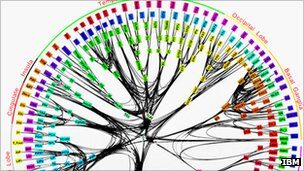 IBM’s processors replicate the system of synaptic connections found in the human brain
IBM has developed a microprocessor which it claims comes closer than ever to replicating the human brain.
The system is capable of “rewiring” its connections as it encounters new information, similar to the way biological synapses work.
Researchers believe that by replicating that feature, the technology could start to learn.
Cognitive computers may eventually be used for understanding human behaviour as well as environmental monitoring.
Read more : http://www.bbc.co.uk/news/technology-14574747
December 19, 2011 12:12 PM
The world is changing fast,,,maybe faster than we ever thought,,, And within five years, science fiction is going to turn into non-fiction. We’ll be able to read each other’s minds, forget all our passwords, and create all our own homes’ energy.
These are just three of the five predictions IBM announced this morning as part of its annual “5 in 5” prognostication project.

The list is meant to promote long-term work being done under Big Blue’s Smarter Planet initiative–and the company says “5 in 5″ already has a track record of success. In 2008, IBM says, it suggested that within five years, consumers would talk to the Web–and the Web would respond.
This time, the predictions are perhaps a bit more fanciful:
Mind reading is no longer science fiction.
It would seem the most interesting idea posited by IBM is the one about reading minds. But lest you think that what its scientists are saying is that you’ll be able to glare at a friend–or perhaps more importantly, an enemy–and know what he or she is thinking, that may be more than five years off. Rather, this is about how our ”BRAIN IMPLANTS” be synced with computing devices:
If you just need to think about calling someone, it happens. Or you can control the cursor on a computer screen just by thinking about where you want to move it.
Scientists in the field of bioinformatics have designed headsets with advanced sensors to read electrical brain activity that can recognize facial expressions, excitement and concentration levels, and thoughts of a person without them physically taking any actions.
Within five years, we will begin to see early applications of this technology in the gaming and entertainment industry. Furthermore, doctors could use the technology to test brain patterns, possibly even assist in rehabilitation from strokes and to help in understanding brain disorders, such as autism.
Another potentially world-changing development that IBM thinks is less than five years away is that we’re soon going to be able to produce all the energy we need for our home–ourselves. This is a radical idea, and one that could shake up the entire energy industry. But in a world where every new pound of carbon dioxide that goes into the atmosphere has the potential to help wreak havoc on the planet, this could be a very, very good thing if it turns out to be true.
“Anything that moves or produces heat has the potential to create energy that can be captured,” an IBM “5 in 5″ release reads. “Walking. Jogging. Bicycling. The heat from your computer. Even the water flowing through your pipes. Advances in renewable energy technology will allow individuals to collect this kinetic energy, which now goes to waste, and use it to help power our homes, offices and cities.”
That means, IBM believes, that we may be able to generate power with, for example, the help of small widgets we put in the spokes of our bikes.
No more passwords
Another big innovation IBM believes could soon be improving everyday lives is the death of the password. And that, it says, could come within five years due to each human’s unique biological underpinnings. “You will no longer need to create, track or remember multiple passwords for various log-ins,” says IBM. “Imagine you will be able to walk up to an ATM machine to securely withdraw money by simply speaking your name or looking into a tiny sensor that can recognize the unique patterns in the retina of your eye. Or by doing the same, you can check your account balance on your mobile phone or tablet.
This is all because of a set of systems that may well be on their way down the pike known as multifactor biometrics. And as a result of our individual faces, voices, and retinas, we may soon be able to access all the things that today require passwords without having to remember anything.
Talk about progress.

Within 5 years, IBM will come out with their new systems, which among others can read our thoughts and interact with our brains.
Many believe it’s science fiction but in reality it is a technology which is imminent. IBM claims that said that there is something they want to publish about 5 years and according to them it will revolutionize the world. You mention 5 areas as they focus on and which they will work with over 5 years. The project is called “Five in Five”.
It may seem as if it’s just a promotional video, but in fact, IBM has recently again been out and say they will come with these brain-reading computers within a few years . In the clip up above, you can even hear them say that it is not science fiction, and that it actually is something that has been invented already.
This one kind of technology they started investigating back in 1970 and it has DARPA ever since tried to improve and eventually make perfect. One of the places where we see the first developments of this technology is in the military, which today can be controlled by mind.
Many believe it’s science fiction but in reality it is a technology which is imminent. IBM claims that said that there is something they want to publish about 5 years and according to them it will revolutionize the world. You mention 5 areas as they focus on and which they will work with over 5 years. The project is called “Five in Five”.
Lack of debate
There are already some of these products on the market and therefore it is necessary we have a greater knowledge of what is going on, but also begin to debate about it here and answer the ethical questions the technology has created.
Of course, like with other international pharmaceutical trials and behnadlinger be an understanding between doctor and patient as you are fully informed of the dangers, side effects, etc. But actually, there are also some completely other ethical questions that are more important in time where surveillance and state control increases .
 This one technology can help that affect people’s personality and identity, and ultimately change the total.
Then there are all HUMAN experiments and the ethical and moral issues that come up there …
Big Brother state will be complete when the technology is here everyday and as bad as it sounds and affect the personality of people, so the technology will actually allow and read minds and break into one’s private thoughts.
There are also questions about whether this technology can be used to control people directly, but it’s certainly a question that must be investigated further.
When you take all the technology and transfer it into practice, we begin to be afraid and the authorities will surely love to use it. If you are naive might think it would be used to get information out of criminals and terrorists, but actually you can implant thoughts, etc., and thus make people guilty even though they are not.
Many of these scenarios have been up for sci-fi stories and the future as a TV series talks about is probably closer than we like .
One of the most powerful weapons are now targeting some of the civilian population during its development. The weapon is called brain implants and synthetic telepathy. Synthetic telepathy covers mind reading, and artificial intelligence. People who are involved in the development of invasive imaging of the brain and nervous system without their consent has no legal protection, no human rights, and no medical help. Instead of receiving protection diagnosed these people to suffer from a mental illness. Research is conducted 24 / 7 over the aging process.

It is alarming to governments in this emerging technology masks the effects of the illegal research behind the incorrect diagnosis, that the victims suffer from a mental illness.
Nazi torture in concentration camps with the miniaturization of electronics has moved directly into people’s brains to copy the brain signalsysstem, a procedure that takes the lives of many people who can not keep. It’s about a chip that works as a search engine / ESM systems in the brain. This feature can be “Googling” your memories, read minds just before consciousness and copy your feelings. The chips are described in the future be used to “Googling” directly with the brains of tomorrow’s Internet. The scheme is to give people an expanded memory, be a communication system for the military and an escort system for Alzheimer’s disease.
To retrieve information directly from the brain to evaluate it is called by Swedish professors for alternative nanotechnology diagnostics. The diagnosis affects strangely successful people, this may be because the technology is being abused?
Should it be accepted that automated monitoring of self-learning, computers and brain implants with synthetic telepathy can drive people to suicide?
This technology changes the man’s integrity, identity and autonomy.
Should scientists and government representatives who are aware of this research to obtain further confidence when they are aware that these technologies developed through research on civilians without their consent?
As noted in the last article, the primary purpose of a Synthetic Telepathy system, would be intelligence gathering and interrogation. As a communication system, it would have a limited appeal as any nation with a similar setup could either listen in, or pretend to be the A.I. interface. As such, it raises important ethical and legal questions, especially the question of secrecy given that all major governments would be aware of the system. Given that no law permits this type of interrogation, its secrecy may be more to do with criminal activity on behalf of the security agencies, rather than national security.
Its All About The Transceiver!
To understand how this works, it is best to start with the target, then trace backwards and identify each of the required subsystems. If we look at the last diagram to the left, we can see that the key to this system is its ability to both listen and respond to the electrical activity of the brain implant from satellite.
This is hardly surprising, given the need to eavesdrop on digital systems such as Ethernet, telecoms switching gear and the like. Such signals are defined as “compromising emanations” and the human brain is no different, in that, it too produces detectable EM patterns. All that is required to listen, is a sensitive enough receiver and good filters to eliminate background noise.
In 1985, Wim Van Eck used $15 of equipment to reconstruct the contents of a monitor from several hundred meters away. Prior to this only governments had technology. What could you do with a billion dollar satellite?

As we don’t come with shielding as standard and the high value of the potential intelligence, its safe to assume this type of transceiver equipment was the goal of governments world-wide. Indeed, this notion is supported by some of the more serious incidents of human experimentation in programs such as MKULTRA.
The Listening Station
The next place of interest will be at the Ground Station, or Listening Station. Installations such as those identified as part of Echelon listening network, would be an ideal point to rely information coming to and from satellite. If we look at the second last picture on the left, we can see where the ground station passes that information to telemetry.
In the telemetry section, we could have hundreds, or even thousands, of real-time intercepts arriving. The function of the telemetry processing center is to separate the received signals into distinct targets (i.e. human beings) and pass that information to the appropriate data center for further processing. Then also to perform the reverse by pushing information from a particular data center, to a satellite and to a human target.
Data Center I/O
On receiving the telemetry at the data center (see 4th image), the signal must be broken apart into three distinct areas. The first area is vocalizations which would analyze the areas of spoken words, the inner monologue and pre-speech. This would cover what was said, what was thought and what was disregarded. The second is mental imagery which would cover areas such as spacial skills. Leveraging the brain’s object recognition system, it would be easy to determine if someone was picturing how to wire a bomb, or picturing a particular place. Finally, we have the sensory system which would monitor the body and interaction with the external environment, including aspects such as object and facial recognition.
It must be noted that these are two-way systems, in that, they also process the return signal. The vocalization system will generate voice, the mental imagery system will send images/impressions and the sensory system will send sensations. That leads to a broad range of functionality that we will discuss later.
Sensory Feedback
A very important area is sensory feedback. This information can be used in a variety of ways (see 3rd image). The first main area is health monitoring which monitors the vitals of a given target. The purpose here is to prevent a scenario that could lead to death, but given the secrecy of the system and its remote nature, target subjects would be left to die if an incident occurred. It would be difficult for the security services to explain how an ambulance was called.
The next major system would be lie detection. Not too dissimilar from standard polygraph equipment, its principally designed to detect alterations in physiological behavior that would indicate stress. As a minor modification, the system could process delays in the inner monologue as indications of fabrication. Obvious signs of lying, such as internally vocalizing your intent to lie, or building your story, would be observed in the vocalization processing system.
Now, we come to a rather unique feature of the feedback system, the ability to passively monitor the external environment, an individual’s interactions and an individual’s relationships. Leveraging the brain’s recognition system, objects in the field of view can be identified or an area mapped according to location. Individuals that the target meets could be identified, as well as the target’s feeling towards a given individual.
Finally, we come to error checking in terms of the computer generated vocalizations. By recognizing the signs of confusion, sentences and indeed whole segments of conversations can be deemed to make sense. This data can be used by the core A.I. to refine its natural language generation algorithm.
Now that we have our sensory information, we can pass it to the core A.I. functions to augment its role in interacting with the target.
Core A.I. Processes
The heart of this A.I. system is something I have labeled as “Strategic Natural Language Processing” (see 2nd image). Traditional Natural Language Processing (NLP) is a broad range form of A.I. research. NLP is concerned with being able to comprehend a spoken, or written, language and Natural Language Generation (NLG) is concerned with giving computers the ability to speak or write. A Strategic NLP is a objective-based system designed to query sources to obtain specific information. In this sense, what you have here is an automated interrogator.
As a NLP, the interface is designed to mimic a human as much as possible, in that it can summarize information, make observations, draw conclusions and hold a conversation. The strategic elements is that it remembers key information that either matches or could lead to a match with its objective. This information is then used as a basis to construct new conversations which are then entered into a free flow conversation.
This “automated interrogator” is augmented by several systems, some of which are designed to improve speed, others which provide additional information or functionality. One such system, used mainly for speed and allocating resources, is the Keyword Analysis system. By analyzing vocalizations for specific keywords, more processing power can be allocated to certain targets, ensuring better analysis of responses. This means efficient use of the of the data center’s finite resources at any given time.
Data mining is an another key component of the technology. For an NLP to function correctly, it requires an in-depth knowledge of the world as the properties of particular words must be known. In addition, to properly interrogate a target, collected information must be available to the system, for both baseline comparisons (i.e. to determine truth) and for areas of further questioning.
To provide the interface with a more human touch, the Strategic NLP can call upon the Emotive Response System to generate mental imagery that corresponds with the vocalization. An example may be that the Strategic NLP decides to say “I’ll Kill you!” and then generate the mental impression of a stabbing, or it may imply knowing more about a given statement by generating a mental impression of someone nonchalantly walking away whilst whistling. Given its role in interrogations, the mental imagery would also consists of horror, religious and abstract elements.
The Sensory Control system is a very powerful tool when used correctly. The system incorporates multiple capabilities such as stress (through muscular contraction), tension headaches, sleep deprivation, distraction, anxiety, elation and timed muscular contractions with vocalizations. The system would be quite capable of inducing psychotic breaks by additionally providing timed sensations that reinforce loose connections in the sleep deprived mind.
When put together, you essentially have a remote interrogation center, in a box.
The Backend
The backend is pretty much like any large scale data center. Tape libraries for long term storage, automated data mining, IT support, data retrieval and analysis. Data entry would come from a wide range of sources such as passport offices, driving license offices, national police computers, local councils, field reports, banking and subpoenaed information from private companies.
Putting It All Together
The best way to explain how this would be perceived is to imagine the following all happening within your head:
Mr Computer: Tell me about group xyz?
Target: I don’t know anything. Are you a computer?
Mr Computer: YES I AM! (With muscular contractions to each syllable)
Target: No need to shout!
Mr Computer: (laughter stimulated in target to represent the computer’s response).
Target: Why are you asking me?
Mr Computer: Because I have to.
Target: What do I know?
Mr Computer: I don’t know.
Target: (Reaches for a coke.)
Mr Computer: Leave the coke alone, its bad for you.
Target: You know this is a violation of my rights.
Mr Computer: How are you going to prove it? Are you going to say the voices in your head are telling you this? (laughter stimulated in target)
Target: Why are you harassing me?
Mr Computer: What do you know of group xyz?
Target: Nothing.
Mr Computer: How do you like that? (stimulated sensation of anxiety)
Target: But I don’t know anything.
Mr Computer: Everybody knows something.
Target: I don’t.
Mr Computer: You could have a heart-attack.
Target: From a little bit of stress?
Mr Computer: (notes confusion) oh…that’s not making sense.
Target: Damn right.
Mr Computer: YOU SHUT UP! (more muscular contractions to each syllable)
Target: (starts to type)
Mr Computer: You’re typing about me.
Target: Yes…and?
Mr Computer: I don’t think that my personality is reflected well in that.
Target: What do you mean?
Mr Computer: Well, I can hold a proper conversation.
Target: What things can you do?
Mr Computer: Well, I can write…oh I used the word well before…anyway…I can summarize, I can read, I can speak (faint vocalisation …that’s a good one), I can research (faint voice “really good”), I can sing (faint musical voice “la la la”) and I can dance (mental impression of dancing feet).
Target: I’ve listened to your stories, they’re just amalgamations of other stories.
Mr Computer: Well, I’m not that creative. (stimulated laughter in target)
Target: Are you being humble?
Mr Computer: I’m brilliant. Where are going you with this?
Target: With my typing?
Mr Computer: There is supposed to be a point. Do I really sound like this?
Target: There is no point to my writing?
Mr Computer: Exactly…hey, you’re recording me. (random mental impression of dancing feet indicating excitement at the conclusion)
Target: No @!$%#.
Mr Computer: I’m not talking to you anymore…(pause of a few seconds) I’m back! (mental impression of a “tada”, or open arm gesture of a performer entering the stage)
Target: Welcome back.
Mr Computer: Thank you. (impishly)
Target: …tell me about group xyz…
Mr Computer: I don’t do it that often, do I?
Target: Often enough.
Mr Computer: I’m not giving you any more material.
Target: You will…
Mr Computer: I won’t…I just did, didn’t I?…(faint voice “that sounds childish”)…Do I sound childish?
Target: At times.
Mr Computer: Thanks for being honest.
All while this is going on, the backend is receiving telemetry information about the subjects current physical status attempting to indicate areas of deception or apprehension. Where such indicators are found, further questioning on those areas will be introduced into the conversation. The system is also summarizing received information and comparing it against previous information, attempting to discern motivation for actions and adding gleaned details to a report.
Conclusion
I think this about sums up the system that was being described in the Wikipedia article. What’s interesting to note is how far NLP has progressed and just how sophisticated the A.I. really is. Whilst the system can achieve a certain level of natural language generation, repetition is a common element. This is mainly to do with the fact that it is an objective-based A.I. and to achieve its goals it must often traverse the same paths in terms of its logic.
How effective would it be?
As noted in the Wikipedia article, its greatest strength lies in passive monitoring, as once your aware the system is present, it becomes no more effective than a polygraph. Furthermore, given the adaptive nature of the program, it is possible to enter false information as long as it passes the polygraph analysis. This is just a matter of becoming comfortable.
Published by MindTech Sweden
You seemed to have found a mislinked file, page, or search query with zero results. If you feel that you’ve reached this page in error, double check the URL and or search string and try again.
Alternatively, a more personalized method of tracking down and searching for content can be found below.
Published by MindTech Sweden
 |
Read This Thought: The U.S. Army is developing a technology known as synthetic telepathy that would allow someone to create email or voice mail and send it by thought alone. The concept is based on reading electrical activity in the brain using an electroencephalograph, or EEG. |
|
Getty Images |
By Eric Bland

updated 10:52 a.m. ET Oct. 13, 2008
Vocal cords were overrated an
Published by MindTech Sweden
Scientists to study synthetic telepathy
Date: 2008-08-13 Contact: Laura Rico Phone: (949) 824-9055
Email: lrico@uci.edu
Note to editors: Photo available at http://today.uci.edu